

An efficiency-first guide to the 2026 Mazda CX-50 Hybrid, including city and highway MPG, road-test results, fuel range, cost savings, and rival comparisons
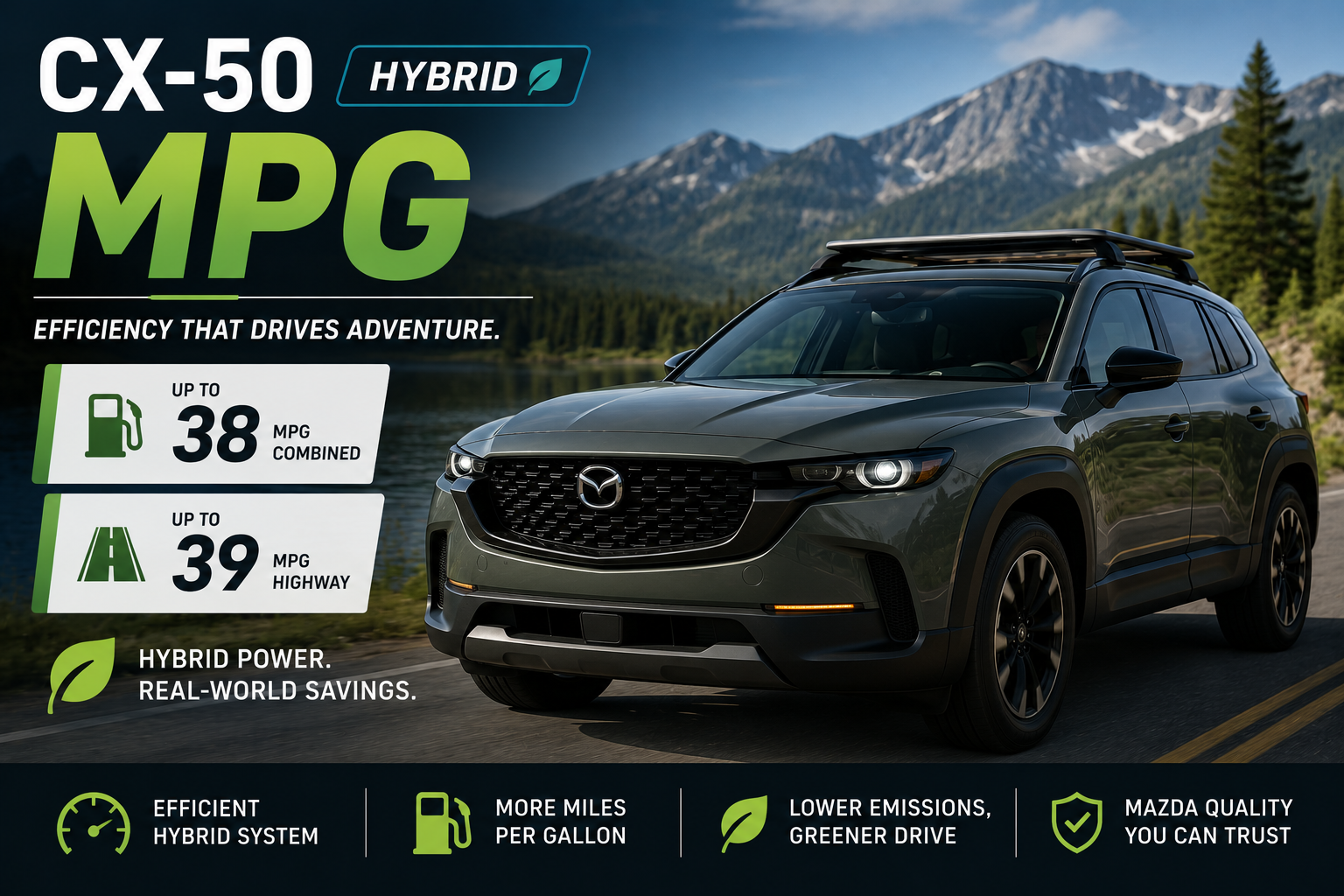
The headline CX-50 Hybrid MPG figure for 2026 is 38 mpg combined. Mazda and the EPA rate the all-wheel-drive hybrid at 39 mpg in the city and 37 mpg on the highway. Those numbers make it dramatically more efficient than the regular gas-powered CX-50, which is rated at about 26 mpg combined in its most efficient 2026 configuration.
The more useful question is whether a driver will actually see 38 mpg. The answer depends heavily on speed, trip length, temperature, traffic, tire pressure, terrain, and how often the hybrid system can recover energy through regenerative braking. At lower and moderate speeds, the CX-50 Hybrid can spend more time using electric assistance. On a fast interstate trip, the gasoline engine does more of the work, so mileage usually falls.
| The short answer
The 2026 Mazda CX-50 Hybrid is EPA-rated at 39 city, 37 highway, and 38 combined mpg. Car and Driver recorded 34 mpg in a controlled 75-mph highway test. Mazda lists a 551-mile total driving range, and the hybrid uses regular 87-octane gasoline. |
Key Takeaways
- 2026 CX-50 Hybrid fuel economy is EPA-estimated at 39 mpg city, 37 mpg highway, and 38 mpg combined.
- All CX-50 Hybrid trims use standard electronic all-wheel drive and the same 219-hp hybrid powertrain, so the main EPA fuel-economy rating is shared across the hybrid lineup.
- Car and Driver achieved 34 mpg on its 75-mph highway fuel-economy test, showing how higher freeway speeds can pull real-world mileage below the 37-mpg highway rating.
- Mazda lists a 551-mile total driving range. The hybrid has a 14.5-gallon fuel tank, so theoretical range closely matches the 38-mpg combined rating multiplied by tank capacity.
- Compared with a 26-mpg gas CX-50, the hybrid can save roughly 146 gallons of fuel every 12,000 miles. At an example gasoline price of $3.50 per gallon, that is about $510 per year.
- The CX-50 Hybrid is competitive with AWD hybrid rivals, but the most efficient 2026 Toyota RAV4 Hybrid configurations return higher EPA ratings.
- City-heavy driving usually favors the hybrid most. Very short cold trips, winter weather, high speeds, roof cargo, heavy loads, towing, and aggressive acceleration can reduce MPG.
What Is the Official 2026 Mazda CX-50 Hybrid MPG?
| EPA Rating | City | Highway | Combined |
| 2026 CX-50 Hybrid e-AWD | 39 mpg | 37 mpg | 38 mpg |
Mazda confirms these figures on its official 2026 CX-50 Hybrid page. Mazda also lists a total driving range of 551 miles and specifies regular 87-octane fuel for the hybrid powertrain.
Unlike some competing hybrid SUVs that offer both front-wheel drive and all-wheel drive, every CX-50 Hybrid includes electronic AWD. That matters when comparing EPA numbers because front-wheel-drive hybrids often post higher ratings than otherwise similar AWD versions.
Why Is the City MPG Higher Than the Highway MPG?
A conventional gasoline vehicle often performs best on the highway because steady cruising avoids repeated acceleration. A hybrid changes that pattern. In city driving, the CX-50 Hybrid can recover energy during deceleration, use its battery and electric motors more often, and shut the gasoline engine off in situations where a conventional engine would continue idling or operating inefficiently.
At 70 to 80 mph, aerodynamic drag rises sharply and the gasoline engine has to contribute more continuously. Regenerative braking also has fewer opportunities to recover energy during a long steady cruise. That is why the EPA city rating is 39 mpg while the highway number is slightly lower at 37 mpg.
What MPG Did the CX-50 Hybrid Get in Real-World Testing?
EPA tests are standardized so vehicles can be compared consistently, but road-test results show what happens under a specific set of conditions. Car and Driver recorded 34 mpg on its 75-mph highway route in a CX-50 Hybrid Premium Plus. That is 3 mpg below the EPA highway rating, but the test is also conducted at a sustained interstate speed where hybrids receive less benefit from electric operation and regenerative braking.
The full test data is available in Car and Driver’s CX-50 Hybrid review, which also reports a 7.6-second 0-to-60-mph time for the hybrid.
In a separate multi-SUV comparison drive, Car and Driver reported a 31-mpg observed result for the Mazda over its broader test route. That lower figure should not be treated as a new EPA rating. It reflects a specific trip with its own speed, terrain, traffic, temperature, and test procedures. The useful lesson is that a real owner should think of 38 mpg as a standardized benchmark rather than a guaranteed tank-by-tank result.
How Far Can the CX-50 Hybrid Go on a Tank?
Mazda lists an EPA-estimated 551-mile total driving range for the 2026 CX-50 Hybrid. The fuel tank holds about 14.5 gallons. Multiplying 14.5 gallons by the 38-mpg combined rating gives almost exactly 551 miles, which explains Mazda’s published range figure.
| Average MPG | Approx. Fuel Used per 500 Miles | Approx. Range from 14.5 Gallons |
| 31 mpg | 16.1 gallons | About 450 miles |
| 34 mpg | 14.7 gallons | About 493 miles |
| 38 mpg | 13.2 gallons | About 551 miles |
| 40 mpg | 12.5 gallons | About 580 miles |
Real fill-up distance will usually be lower than the theoretical maximum because drivers do not normally run the tank completely dry, and the dashboard range estimate adapts to recent driving conditions. Cold weather, hills, sustained high speed, or a roof box can also reduce the displayed range.
How Much Fuel Can the Hybrid Save Versus the Regular CX-50?
Mazda lists the regular 2026 CX-50 at about 26 mpg combined in its most efficient configuration, compared with 38 mpg combined for the hybrid. That 12-mpg difference is large enough to matter for drivers who put substantial mileage on the vehicle.
| Annual Miles | Hybrid at 38 MPG | Gas CX-50 at 26 MPG | Fuel Saved | Savings at $3.50/Gal. |
| 12,000 | 316 gal. | 462 gal. | 146 gal. | About $510/yr |
| 15,000 | 395 gal. | 577 gal. | 182 gal. | About $638/yr |
These are simple examples, not forecasts. Gasoline prices vary by state and over time, and individual mileage can differ from EPA estimates. Still, they show why the hybrid makes the strongest financial case for drivers with longer commutes or high annual mileage.
Does the Hybrid Price Premium Pay Back Through Fuel Savings?
Mazda lists the 2026 CX-50 2.5 S Preferred at $32,400 before destination and the Hybrid Preferred at $34,750, a simplified MSRP difference of $2,350. At 12,000 miles per year, 38 versus 26 mpg, and an example fuel price of $3.50 per gallon, the fuel-only savings work out to roughly $510 per year. On those assumptions, the price difference is recovered in about 4.6 years.
At 15,000 miles per year, the simplified fuel-only payback falls to roughly 3.7 years. This calculation should not be treated as a full ownership-cost analysis because trim equipment, financing, insurance, resale value, maintenance, taxes, incentives, and actual transaction prices can all change the result.
How Does CX-50 Hybrid MPG Compare With Other 2026 Hybrid SUVs?
The CX-50 Hybrid is efficient, but it is not the class leader. The fairest comparison is with AWD rivals because electronic AWD is standard on every Mazda hybrid.
| 2026 Hybrid SUV | City MPG | Highway MPG | Combined MPG |
| Mazda CX-50 Hybrid AWD | 39 | 37 | 38 |
| Honda CR-V Hybrid AWD | 40 | 34 | 37 |
| Hyundai Tucson Hybrid SE AWD | 38 | 38 | 38 |
| Toyota RAV4 Hybrid AWD | Varies by trim | Varies by trim | About 41-42 |
The comparison shows the Mazda sitting near the middle of the efficient AWD hybrid group. The 2026 RAV4 Hybrid has a clear EPA advantage in many AWD trims, while the CX-50 roughly matches the Tucson Hybrid SE AWD and slightly exceeds the CR-V Hybrid AWD on combined rating. The Mazda’s appeal is therefore not fuel economy alone. It combines competitive efficiency with a more driver-focused chassis and a cabin that often feels closer to an entry-luxury product than a typical mainstream compact SUV.
What Powertrain Produces 38 MPG?
The 2026 CX-50 Hybrid uses a 2.5-liter naturally aspirated four-cylinder gasoline engine, a hybrid battery, three electric motors, an electronically controlled continuously variable transmission, and electronic all-wheel drive. The system produces 219 horsepower and 163 lb-ft of engine torque and runs on regular 87-octane gasoline.
The underlying hybrid architecture is based on the Toyota Hybrid System, but Mazda tuned the vehicle around its own steering, suspension, accelerator response, and drive-mode priorities. The CX-50 Hybrid also includes Power and Trail modes through Mazda Intelligent Drive Select.
What Lowers CX-50 Hybrid MPG in the Real World?
- High interstate speed: Fuel economy generally drops as aerodynamic drag rises, particularly above typical EPA test speeds.
- Cold weather: The engine may run more often to warm the cabin, battery performance changes, and winter tires can add rolling resistance.
- Short trips: A hybrid may spend much of a brief trip warming up rather than operating at peak efficiency.
- Aggressive acceleration: Strong throttle inputs demand more gasoline-engine power and reduce opportunities for efficient electric assistance.
- Heavy braking: Regenerative braking can recover energy, but abrupt stops can require the friction brakes and waste more kinetic energy as heat.
- Low tire pressure: Underinflated tires increase rolling resistance and can reduce fuel economy.
- Roof racks and cargo boxes: Extra aerodynamic drag can have a noticeable effect on highway MPG.
- Heavy payload or towing: More mass requires more energy to accelerate and climb grades. The CX-50 Hybrid is rated to tow up to 1,500 pounds when properly equipped, but towing fuel economy can fall substantially.
How Can You Get Closer to the EPA Rating?
There is no special trick required. Hybrid efficiency usually improves when the driver avoids unnecessary energy losses and lets the powertrain do what it was designed to do.
- Accelerate smoothly rather than using repeated heavy throttle inputs.
- Look farther ahead so you can slow gradually and maximize regenerative braking.
- Keep tires at the pressure listed on the driver-door placard, checking them when cold.
- Remove roof boxes or heavy accessories when they are not needed.
- Combine very short errands when practical so the engine spends less time repeatedly warming up.
- Use climate control normally, but understand that maximum heat in winter and heavy air-conditioning demand can affect fuel use.
- Judge mileage over several tanks instead of one short trip. Weather, traffic, and a single road trip can distort the dashboard average.
Is the CX-50 Hybrid Good for Highway Driving?
Yes, but highway driving is not where its efficiency advantage is largest. The 37-mpg EPA highway rating is still strong for an AWD compact SUV, and a theoretical 500-mile-plus range can make it a capable road-trip vehicle. However, buyers who spend nearly all their time at 75 to 80 mph should expect a smaller fuel-economy advantage than drivers with a mixed commute.
Car and Driver’s 34-mpg result at 75 mph is a useful benchmark for that kind of use. It is still considerably better than the 29 to 30 mpg highway ratings of gas CX-50 variants, but it is below the hybrid’s official 37-mpg highway figure.
Is the CX-50 Hybrid MPG Worth the Tradeoffs?
For many buyers, yes. Going from roughly 26 mpg combined in a gas CX-50 to 38 mpg combined is a major improvement, and the hybrid keeps standard AWD, 219 horsepower, and the basic CX-50 driving position and design. The strongest use case is a driver who wants Mazda styling and road manners but covers enough annual mileage for fuel savings to matter.
The tradeoffs are real. The hybrid is rated to tow only 1,500 pounds, while the turbo CX-50 can tow up to 3,500 pounds when properly equipped. The eCVT can also sound coarse under hard acceleration, and Car and Driver found the hybrid slower to 60 mph than the turbo model. Buyers who prioritize towing or acceleration may prefer the gasoline turbo even though it uses more fuel.
Frequently Asked Questions
What is the 2026 Mazda CX-50 Hybrid MPG?
The EPA estimate is 39 mpg city, 37 mpg highway, and 38 mpg combined. Electronic all-wheel drive is standard.
What MPG does the CX-50 Hybrid get at 75 mph?
Car and Driver recorded 34 mpg in its controlled 75-mph highway fuel-economy test. Your result can differ with weather, speed, traffic, elevation, tires, and cargo.
How many miles can a CX-50 Hybrid go on a full tank?
Mazda lists an EPA-estimated total driving range of 551 miles. The vehicle has a 14.5-gallon fuel tank, but real fill-up distance varies and drivers normally refuel before using every gallon.
Does the CX-50 Hybrid require premium gas?
No. Mazda specifies regular 87-octane gasoline for the 219-hp CX-50 Hybrid powertrain.
Is the CX-50 Hybrid more fuel-efficient than the gas CX-50?
Yes. The hybrid is rated at 38 mpg combined, while Mazda lists the regular 2026 CX-50 at about 26 mpg combined. That is roughly a 46 percent increase in miles traveled per gallon based on the two combined ratings.
Does every CX-50 Hybrid get the same MPG?
Mazda publishes the same 39 city, 37 highway, and 38 combined EPA estimate for the 2026 CX-50 Hybrid lineup. Wheel and tire differences, options, temperature, driving style, and road conditions can still affect actual mileage.
Is 38 MPG Good Enough to Choose the Hybrid?
The 2026 Mazda CX-50 Hybrid is not the highest-MPG compact hybrid SUV in America, but its 38-mpg combined rating is strong because every version includes AWD. It improves efficiency dramatically over the gas CX-50 without turning the vehicle into a front-wheel-drive economy crossover.
For city and mixed-use drivers, the hybrid can cut fuel consumption substantially. For high-speed highway drivers, the improvement is smaller but still meaningful, with independent testing showing 34 mpg at 75 mph. The decision is therefore less about chasing a single MPG number and more about matching the hybrid’s strengths to your actual driving pattern.
If your priority is maximum towing or the quickest CX-50 acceleration, the turbo remains the better match. If your priority is lower fuel use, long range between fill-ups, standard AWD, and a more efficient daily commute, the CX-50 Hybrid is the version that makes the strongest case.
Research note: Fuel-economy ratings, powertrain details, range, pricing, and towing information were checked against Mazda and current U.S. 2026 model-year information in August 2026. Independent road-test data came from the supplied Car and Driver reference. EPA ratings are estimates for comparison, and actual mileage varies with driving conditions and vehicle use.