


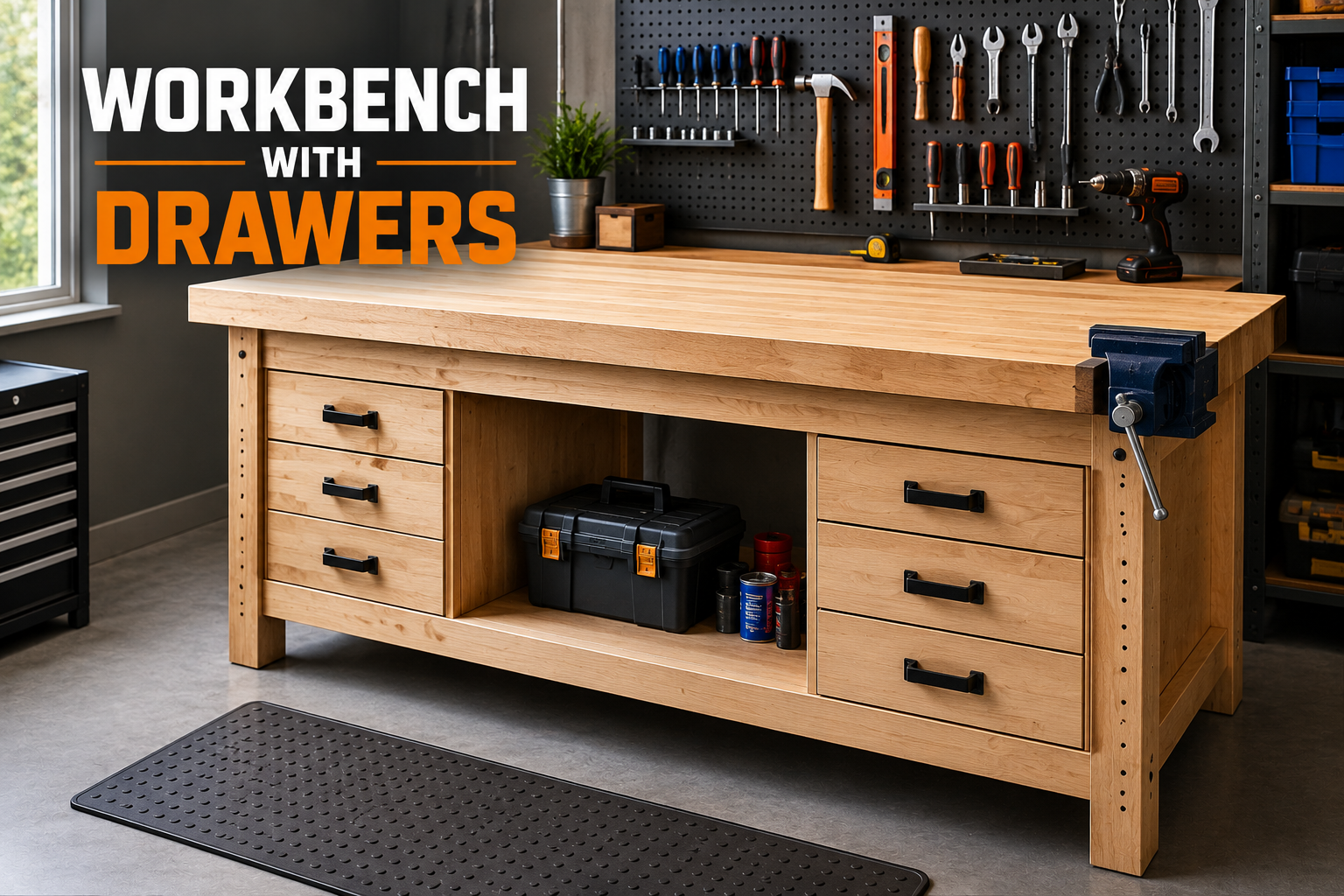
A drawer-equipped workbench can replace a table, tool chest, and storage cabinet, but only if the layout matches the work you do.
A workbench with drawers sounds simple until you start comparing models. Some are essentially tool cabinets with a wood top. Others are traditional benches with one shallow organizer drawer. A few combine deep storage, locking drawers, cabinets, casters, pegboards, power strips, and heavy-duty work surfaces into one large garage station.
The best choice is not automatically the bench with the most drawers. A mechanic needs shallow full-extension drawers for sockets and hand tools. A woodworker may prefer open legroom, a thick top, and only a few drawers. A small garage may benefit more from a 46-inch rolling bench than a 72-inch stationary unit that blocks a parking bay.
For 2026, Car and Driver’s tested garage workbench guide reinforces the same basic idea: stationary, rolling, folding, and storage-focused benches solve different problems. The smartest way to shop is to design the storage and work surface around your garage first, then choose the bench.
| KEY TAKEAWAYS
· Drawer count matters less than drawer depth, width, slide capacity, and how well the layout matches your tools. · A 36- to 48-inch bench works well in compact garages, while 60- to 72-inch benches make more sense for larger tool collections and assembly work. · Wood tops are comfortable and repairable; stainless steel resists liquids and is easier to clean; composite tops are practical for lighter-duty use. · Rolling benches add flexibility, but stationary legs provide better stability for hammering, clamping, and high-force work. · Look for full-extension ball-bearing slides, a keyed lock, sturdy casters, realistic total load ratings, and drawers that can handle concentrated tool weight. · Measure drawer interiors, not just the outside dimensions of the bench. |
Start With a Bench Blueprint, Not a Brand Name
Before comparing products, map your garage into four zones: work surface, hand-tool storage, bulky-tool storage, and movement space. A workbench with drawers succeeds when it keeps frequently used tools within reach without turning the benchtop into permanent storage.
Use painter’s tape on the floor to mark the footprint of the bench you are considering. Open your car doors, roll a floor jack through the area, and check whether a garage refrigerator, trash can, or lawn equipment will still fit. A bench that looks modest online can feel huge once it is 24 inches deep and surrounded by open drawers.
How Wide Should a Workbench With Drawers Be?
Width is the first major decision because it controls both work area and storage capacity.
| Bench Width | Best Fit | Main Tradeoff |
| 36 to 40 in. | Single-car garage, apartment garage, light DIY | Easy to place, limited drawer volume |
| 46 to 52 in. | General automotive and home repair | Good balance of surface and storage |
| 60 to 65 in. | Serious DIY, mixed tool collection | More drawer banks, larger work surface |
| 72 in. and up | Large garage, fabrication, shared workspace | Excellent capacity, requires dedicated wall space |
A 46-inch bench is a particularly useful middle ground. It is wide enough for brake parts, a vise, small engine components, power tools, or household projects, but it can still fit along shorter garage walls.
Larger benches become more useful when you need two working zones at once. For example, one end can hold a vise while the other remains clear for assembly or measuring.
Do You Need Nine Drawers, or Just Better Drawers?
More drawers sound better, but poorly sized drawers waste space. A garage bench should normally mix shallow drawers for sockets, wrenches, pliers, and measuring tools with at least one deeper drawer or cabinet for power tools and bulky supplies.
Shallow drawers are valuable because they prevent tools from stacking on top of one another. A two-inch or three-inch drawer can hold a complete socket set efficiently. Deep drawers are better for cordless drills, impact wrenches, sanders, chargers, and cases.
The most important specification is often drawer load capacity. A drawer full of sockets and ratchets can become surprisingly heavy. Full-extension ball-bearing slides also matter because they let you access items at the back instead of losing the rear third of the drawer.
A keyed locking system is useful even in a home garage. It can keep children away from sharp tools, prevent casual access to expensive equipment, and stop drawers from sliding open while a rolling bench is moved.
What Does a Practical Drawer Layout Look Like?
Instead of organizing by tool brand, organize by task. That reduces walking and searching.
- Top shallow drawer: measuring tools, markers, utility knives, flashlights, inspection mirrors, and frequently used hand tools.
- Second drawer: ratchets, sockets, extensions, and torque accessories.
- Third drawer: wrenches, pliers, cutters, and screwdrivers.
- Medium drawer: cordless drills, drivers, batteries, and chargers.
- Deep drawer or cabinet: grinders, sanders, jigsaws, detailing tools, cases, and larger automotive tools.
- Side cabinet: fluids, rags, shop towels, gloves, cleaners, and items that do not fit drawer organizers well.
Foam inserts and drawer dividers can help, but leave some flexible space. A perfectly fitted drawer can become inconvenient the moment you buy a longer ratchet or a second cordless tool.
Which Worktop Material Is Best?
Wood: Best All-Around Choice
A solid wood or butcher-block top is comfortable, quiet, and easy to repair. It is friendly to painted parts and finished surfaces, and you can usually sand out moderate damage. Wood is also easier to drill when mounting a vise, grinder, or small benchtop machine.
The downside is liquids. Oil, brake fluid, solvents, water, and chemicals can stain or damage an unprotected surface. Polyurethane-coated tops are easier to clean, but the coating will eventually show wear.
Stainless Steel: Best for Easy Cleanup
Stainless steel is appealing for detailing, electronics, light mechanical work, and tasks involving liquids. It wipes clean easily and does not absorb oil. It can scratch and dent, however, and a metal surface is noisier when tools are placed on it.
A stainless worktop also requires more care when working with painted or delicate components because a hard metal surface can mark them.
Composite or MDF-Based Tops: Best for Light Duty
Composite work surfaces can be adequate for general household projects and hobby use. They are usually less expensive, but they are not the first choice for a bench that will hold a heavy vise, transmission parts, or repeated hammering.
Rolling or Stationary: Which Is Better?
Mobility is useful in a garage because the ideal work location changes. A rolling bench can move beside a vehicle for brake work, then return to the wall when the project is finished. It can also serve as a temporary assembly island.
For a mobile bench, caster quality matters almost as much as the frame. Small, narrow wheels struggle with expansion joints, floor cracks, cords, and small debris. Larger 5-inch casters roll more easily when the bench is loaded.
At least two casters should lock securely. For very heavy benches, a combination of fixed and swivel casters can track more predictably, while four swivels make tight positioning easier.
A stationary bench remains the better choice when you plan to mount a large vise, use a bench grinder aggressively, hammer on parts, or clamp long material. Adjustable leveling feet are valuable on garage floors that slope toward the door.
How Much Weight Capacity Do You Really Need?
Manufacturers often advertise a large total weight capacity, but that number is only part of the story. You should compare three separate ratings when available: total bench capacity, worktop capacity, and individual drawer capacity.
A 1,000-pound or 2,000-pound total rating can be impressive, yet a drawer may still be limited to 30 or 50 pounds. Conversely, some tool-storage benches use reinforced slides that can carry much heavier drawers.
For example, Harbor Freight currently lists its YUKON 46-inch 9-Drawer Mobile Storage Cabinet with a 1,200-pound tool-storage capacity and a solid wood top. It is a good example of a bench that behaves more like a rolling tool chest with a work surface.
If you plan to store dense tools such as sockets, pullers, drill bits, and metal fixtures, prioritize drawer ratings and slide quality over a dramatic total-capacity number.
Three Workbench Styles Worth Understanding in 2026
- The Tool-Chest Workbench
This design puts multiple drawers directly under a full worktop. It is ideal for automotive work and garages where tool storage is the main problem. The downside is reduced knee space, so it is not as comfortable for seated tasks.
A current example is the YUKON 46-inch 9-drawer mobile cabinet. Its compact width and high storage density suit a one-car or two-car garage where every square foot matters.
- The Drawer-and-Cabinet Hybrid
This layout mixes drawers with enclosed cabinet space. Drawers handle organized hand tools while the cabinet stores cases, bottles, larger power tools, and irregular items.
This is often the best design for a mixed-use garage because not everything belongs in a drawer. A cabinet can also hold shop supplies upright, which reduces wasted space.
- The Traditional Bench With Limited Drawers
Some benches use only one or two drawers and leave most of the area below the top open. This design is better for woodworking, seated repair work, clamping, and projects that need legroom.
Seville Classics currently offers several examples, from a compact rolling bench to larger storage-heavy models. Its UltraHD workbench lineup includes wood-top, rolling, adjustable-height, lighted, and multi-drawer configurations.
One current 48-inch UltraHD rolling workbench uses a one-inch wood top, one full-extension drawer, four 3-inch wheels, and a 500-pound total capacity. At the other extreme, Seville’s 77-inch multi-drawer benches combine 11 or 12 drawers with cabinets and a large wood surface.
What Features Are Worth Paying Extra For?
- Full-extension ball-bearing drawer slides, especially for deep drawers.
- A real solid wood or replaceable work surface.
- Large locking casters on mobile benches.
- Integrated power strip if you regularly charge cordless tools at the bench.
- Pegboard or slatwall when you need frequently used tools visible instead of hidden in drawers.
- Adjustable height if multiple people use the bench or you alternate between seated and standing work.
- Drawer liners to reduce movement and protect tool finishes.
- Locking drawers and cabinets for security and safety.
- Replaceable parts such as casters, drawer slides, and worktops.
Which Features Are Often Overrated?
Built-in USB ports are convenient, but they are easy to add later with a quality power strip. Decorative stainless drawer fronts do not improve storage. An enormous advertised weight rating may not matter if your actual projects never exceed a few hundred pounds.
Likewise, a pegboard is only useful if you want tools visible. In a dusty garage, drawers may keep tools cleaner. Choose features that change how you work, not features that photograph well.
How Tall Should Your Workbench Be?
Most garage workbenches land near 34 to 39 inches high. That works for general standing tasks, but the ideal height depends on your body and the work.
For forceful tasks such as planing, sanding, or heavy assembly, a slightly lower surface can be comfortable because you can lean into the work. For detailed electronics, cleaning, or small-parts work, a higher surface reduces bending.
If two people of different heights use the bench regularly, an adjustable-height model can be worth the premium. Otherwise, a fixed bench at a comfortable standing height is usually stronger and simpler.
How Deep Should a Garage Workbench Be?
Around 20 to 25 inches works well for most garages. A deeper bench gives more room for parts and equipment, but it also consumes floor space and can make the rear edge difficult to reach.
If the bench sits against a wall with pegboard or cabinets above it, 24 inches is a practical target. If you plan to work from both sides of an island bench, a deeper surface may be worthwhile.
What Should You Check Before Buying?
| Check | Why It Matters |
| Exterior dimensions | Will it fit the wall, doorway, and parking space? |
| Drawer interior size | Will socket rails, torque wrenches, and power tools actually fit? |
| Drawer load rating | Can dense tool collections be stored safely? |
| Worktop thickness | Can it support a vise or bench-mounted tool? |
| Caster diameter | Will it roll over garage joints and debris? |
| Locking system | Do drawers stay secure when parked or moved? |
| Assembly requirements | Can the bench be safely assembled in your space? |
| Replacement parts | Can you replace casters, keys, slides, or the top later? |
What Is a Reasonable Budget in 2026?
Workbench pricing varies widely because the category overlaps with tool chests, industrial benches, and garage furniture.
A basic rolling or single-drawer bench can start in the low hundreds of dollars. A midrange mobile workbench with multiple drawers commonly lands around several hundred dollars. Large commercial-style benches with 10 or more drawers, locking cabinets, heavy steel construction, and thick wood tops can cost $1,000 or more.
Current examples show how wide the range is. Harbor Freight lists its 46-inch YUKON 9-drawer cabinet around the mid-$300 range at the time of writing, while Seville Classics lists larger 11- and 12-drawer UltraHD rolling benches around $1,200. Prices, promotions, colors, shipping terms, and store availability can change.
For most home garages, the best value is often in the middle. Buy enough structure and drawer quality to last, but do not pay for commercial capacity you will never use.
Should You Buy a Workbench With Drawers or Separate Pieces?
A combined bench is cleaner and more space-efficient. It gives the garage one footprint for both work and storage. The tradeoff is flexibility.
Separate pieces let you replace the worktop, cabinet, or tool chest independently. You can also create legroom under part of the bench and roll a tool chest underneath only when needed.
If you expect your tool collection to grow quickly, a modular setup may age better. If you want a compact garage to look organized immediately, an integrated workbench with drawers is usually easier.
Frequently Asked Questions
Is a workbench with drawers better than a tool chest?
It depends on how you work. A workbench with drawers combines storage and a usable surface, while a dedicated tool chest usually maximizes storage density. If floor space is limited, a combined bench can be more efficient.
What is the best workbench depth for a garage?
About 20 to 25 inches works well for most home garages. It provides enough work area without projecting too far into a parking bay.
Are wood workbench tops durable?
Yes. A thick, sealed wood top can handle years of normal garage use and can often be sanded or refinished. Protect it from prolonged exposure to automotive fluids and strong solvents.
Do I need locking drawers?
They are useful if children have garage access, expensive tools are stored inside, or the bench is mobile. Locks also help keep drawers closed during movement.
Are rolling workbenches stable enough for a vise?
Some are, but stability depends on caster size, wheel locks, frame stiffness, top thickness, and the size of the vise. Heavy hammering and high-force work are generally better on a stationary bench or a mobile bench with very robust locking casters.
How many drawers should a garage workbench have?
There is no ideal number. A smaller tool collection may work well with one drawer plus cabinets, while a mechanic may prefer eight to twelve drawers. Interior dimensions and load ratings matter more than the count.
The Bottom Line
A good workbench with drawers should make the garage easier to use every day. It should give you a clear work surface, keep frequently used tools within reach, protect expensive equipment, and fit the garage without creating a new obstacle.
For compact spaces, a 46- to 48-inch rolling bench is often the sweet spot. For larger workshops, a 60- to 72-inch bench gives more room for drawer banks and simultaneous projects. Wood tops remain the most versatile choice, while stainless steel is easier to clean around liquids.
Most importantly, shop the drawer layout rather than the marketing photo. Measure your longest tools, heaviest drawers, available wall space, and preferred work height first. A bench with fewer well-designed drawers can be far more useful than a larger cabinet filled with compartments that do not match the way you work.
Product specifications and example prices were checked against current U.S. manufacturer and retailer information available in August 2026. Prices, availability, promotions, capacities, finishes, and model details may change.