


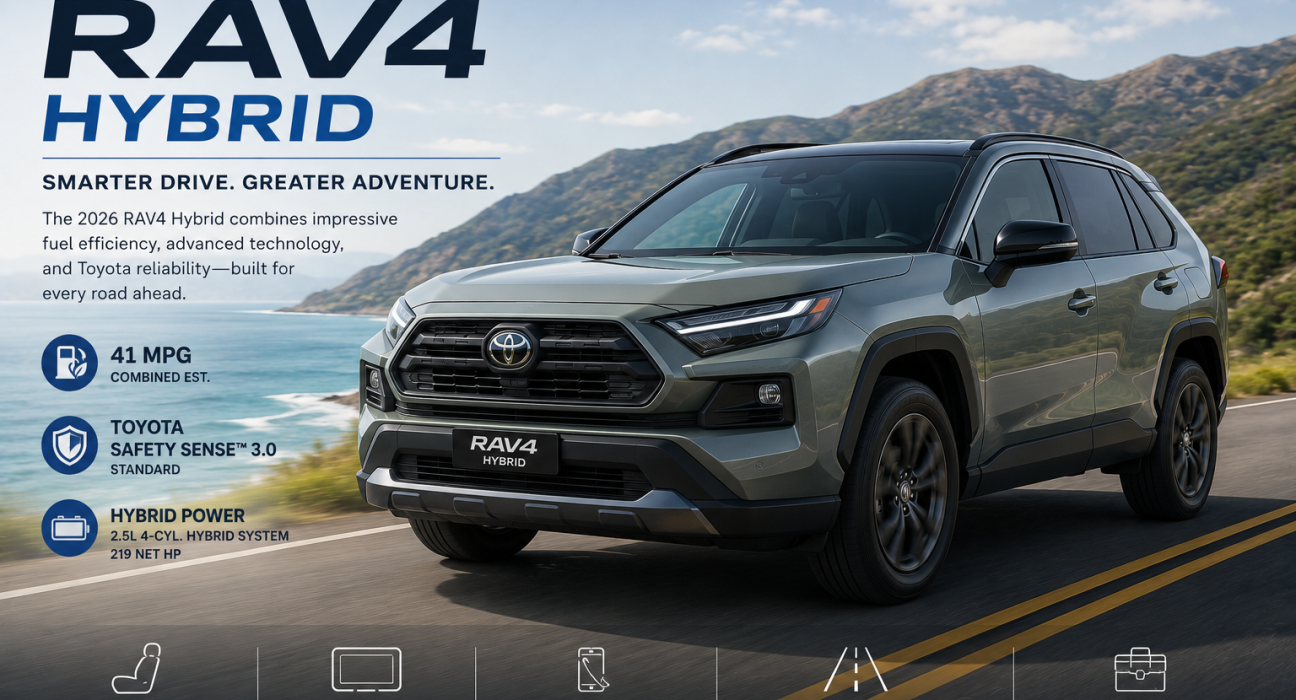
The redesigned RAV4 is hybrid-only for 2026, but fuel economy still varies meaningfully by drivetrain, wheels, tires, and trim.
The headline number for the 2026 Toyota RAV4 Hybrid is excellent: up to 47 mpg city, 40 mpg highway, and 43 mpg combined. That rating belongs to the most efficient front-wheel-drive versions, not every RAV4 in the lineup.
Choose all-wheel drive, larger wheels, extra equipment, or the trail-oriented Woodland trim and the numbers change. The difference is not dramatic, but it is large enough to matter if you drive 12,000 to 20,000 miles a year.
Toyota’s current 2026 RAV4 specifications list the standard hybrid lineup from $31,900 and fuel economy as high as 47 city / 40 highway mpg. The redesigned sixth-generation RAV4 also drops the previous gas-only powertrain, so every regular 2026 RAV4 now uses a gas-electric hybrid system. A separate plug-in hybrid lineup remains available for buyers who want electric-only driving capability.
| KEY TAKEAWAYS
· Best 2026 RAV4 Hybrid EPA rating: 47 city / 40 highway / 43 combined mpg on LE, SE, and XLE Premium front-wheel-drive models. · LE and SE AWD models are rated at 46 / 39 / 42 mpg. · XLE Premium AWD is rated at 45 / 38 / 41 mpg. · XSE and Limited AWD are rated at 43 / 37 / 41 mpg. · Woodland AWD is the least efficient standard hybrid at 41 / 35 / 38 mpg, mainly because its all-terrain setup prioritizes capability over maximum economy. · Car and Driver recorded 36 mpg on its 75-mph highway test of a 2026 RAV4 Hybrid Limited AWD, just 1 mpg below that trim’s EPA highway rating. |
2026 RAV4 Hybrid MPG by Trim: The Efficiency Ladder
The easiest way to understand the lineup is to think of it as an efficiency ladder. Front-wheel-drive trims sit at the top, conventional AWD models remain close behind, and the more aggressive Woodland gives up the most fuel economy.
| Trim | City MPG | Hwy MPG | Combined | 2026 Pricing Context |
| LE FWD | 47 | 40 | 43 | $31,900 |
| SE FWD | 47 | 40 | 43 | $34,700 |
| XLE Premium FWD | 47 | 40 | 43 | $36,100 |
| LE AWD | 46 | 39 | 42 | Varies by drivetrain |
| SE AWD | 46 | 39 | 42 | Varies by drivetrain |
| XLE Premium AWD | 45 | 38 | 41 | Varies by drivetrain |
| XSE AWD | 43 | 37 | 41 | $41,300 base trim price |
| Limited AWD | 43 | 37 | 41 | $43,300 base trim price |
| Woodland AWD | 41 | 35 | 38 | $39,900 |
The table highlights a useful buying point: the fuel-economy penalty for adding AWD to an LE or SE is only about 1 mpg combined. The penalty becomes more noticeable as wheels, tires, weight, and equipment change farther up the range.
Why Does the Front-Wheel-Drive RAV4 Get 43 MPG Combined?
For 2026, Toyota introduced a newer generation of its hybrid system to the RAV4. The powertrain still centers on a 2.5-liter four-cylinder gasoline engine working with electric motor-generators and a lithium-ion battery, but the redesigned system improves both efficiency and output.
Front-wheel-drive RAV4 Hybrid models produce 226 net combined horsepower. Toyota says the system can recover energy through regenerative braking and use electric assistance during low-load driving, acceleration, and other conditions where doing so improves efficiency.
The key advantage of the FWD version is simple: it does not need the dedicated rear electric motor used for electronic on-demand AWD. That reduces drivetrain losses and some weight, which helps the LE, SE, and XLE Premium reach the top 43-mpg combined rating.
Drivers who spend most of their time on dry pavement, urban roads, and normal highways may therefore get the best fuel economy from a front-wheel-drive trim without giving up the basic benefits of Toyota’s hybrid system.
How Much MPG Do You Lose With AWD?
Less than many buyers might expect.
The LE and SE AWD models are rated at 46 city, 39 highway, and 42 combined mpg. That is only 1 mpg lower in each EPA category than the equivalent front-wheel-drive versions.
The XLE Premium AWD falls to 45 city, 38 highway, and 41 combined mpg. XSE and Limited AWD models are rated at 43 city, 37 highway, and 41 combined.
Toyota’s electronic on-demand AWD system does not use a conventional mechanical driveshaft to power the rear axle. Instead, a dedicated rear electric motor adds traction when needed. The AWD system contributes to the 236-hp combined output, 10 hp more than FWD versions.
For buyers in snowbelt states or anyone who regularly deals with steep, wet, loose, or unpaved roads, giving up roughly 1 to 2 combined mpg may be a reasonable trade for the extra traction.
Why Is the Woodland Only Rated at 38 MPG Combined?
The Woodland is designed for buyers who want more adventure-oriented hardware, so outright efficiency is not its only objective.
Toyota gives the 2026 Woodland all-terrain tires, 18-inch wheels, raised black roof rails with crossbars, and other equipment aimed at rougher roads and outdoor use. All-terrain tires generally create more rolling resistance than road-focused tires, and exterior accessories can also influence aerodynamic drag.
The result is an EPA rating of 41 mpg city, 35 mpg highway, and 38 mpg combined.
That is still strong fuel economy for a compact SUV with AWD and more rugged equipment, but it is 5 mpg lower combined than the most efficient RAV4 Hybrid. If most of your driving is suburban commuting, the Woodland’s fuel penalty may be difficult to justify. If you actually use its tire and accessory package, the tradeoff makes more sense.
What MPG Did the 2026 RAV4 Hybrid Get in Real-World Testing?
EPA ratings are standardized estimates, so real-world testing is useful. In Car and Driver’s 2026 RAV4 Hybrid test, an AWD Limited achieved 36 mpg on the publication’s 75-mph highway fuel-economy loop.
That result is important for two reasons. First, it is close to the Limited’s 37-mpg EPA highway rating. Second, it improves on Car and Driver’s test result for the previous-generation RAV4 Hybrid, which returned 32 mpg in the comparison cited in the 2026 test.
High-speed highway driving is often less favorable to hybrids than stop-and-go city driving because there are fewer opportunities to recapture braking energy and the gasoline engine runs more consistently. If your commute is dominated by 70 to 80 mph interstate driving, expecting the city rating is unrealistic even in ideal conditions.
How Does 2026 MPG Compare With the 2025 RAV4 Hybrid?
The redesign delivers a measurable efficiency improvement.
The 2025 RAV4 Hybrid was generally rated around 41 mpg city, 38 mpg highway, and 40 mpg combined for its mainstream AWD configurations. The 2026 model can now reach 43 mpg combined with FWD, while some AWD versions achieve 42 mpg combined.
There is also a performance gain. The outgoing RAV4 Hybrid produced 219 hp with standard AWD. For 2026, output rises to 226 hp with FWD and 236 hp with AWD.
That combination matters because fuel-economy improvements sometimes arrive with weaker performance. Here, Toyota increased output while still pushing the most efficient versions above the old model’s combined rating.
What Could 43 MPG Mean for Your Annual Gas Use?
EPA mpg becomes easier to understand when translated into gallons.
Suppose you drive 12,000 miles a year. At 43 mpg combined, you would use roughly 279 gallons. At 42 mpg, about 286 gallons. At 41 mpg, about 293 gallons. A 38-mpg Woodland would use about 316 gallons.
Using an illustrative gasoline price of $3.50 per gallon, that works out to approximately:
| Combined MPG | Gallons at 12,000 Miles | Fuel Cost at $3.50/Gal |
| 43 mpg | 279 gal | $977 |
| 42 mpg | 286 gal | $1,000 |
| 41 mpg | 293 gal | $1,024 |
| 38 mpg | 316 gal | $1,105 |
The spread from 43 to 38 mpg is only about $128 per year in this example. That means trim choice should not be based on fuel economy alone. Purchase price, AWD needs, tires, comfort features, insurance, and expected resale value can easily matter more.
How Far Can a 2026 RAV4 Hybrid Go on a Tank?
Toyota lists a 14.5-gallon fuel tank for the RAV4. Multiplying the tank capacity by the EPA combined rating produces a theoretical figure above 600 miles for a 43-mpg version.
Do not treat that number as a guaranteed driving range. Vehicles keep a reserve, driving conditions vary, and actual fuel economy changes with speed, temperature, elevation, traffic, tire pressure, cargo, and climate-control use.
A more useful habit is to track several full tanks rather than judging the vehicle from one trip-computer reading. Hybrid fuel economy can vary noticeably from one commute to another, especially during winter or repeated short trips.
Why Can Your RAV4 Hybrid MPG Be Lower Than the EPA Rating?
A new RAV4 that shows 34 or 35 mpg on one trip is not automatically defective. Several normal conditions can pull the average down.
- Cold weather: the engine runs more often to warm itself and heat the cabin.
- Short trips: the powertrain spends a larger percentage of the drive warming up.
- High interstate speeds: aerodynamic drag rises quickly as speed increases.
- Hard acceleration: requesting high power keeps the gasoline engine working harder.
- Low tire pressure: added rolling resistance reduces efficiency.
- Roof racks, cargo boxes, or bikes: exterior gear increases aerodynamic drag.
- Heavy cargo or towing: extra mass and load require more energy.
- All-terrain tires: tougher tread patterns can reduce efficiency compared with road-focused tires.
How Can You Get Closer to the EPA MPG?
You do not need to drive painfully slowly. Consistency matters more.
Accelerate smoothly, leave enough space to coast early, and brake progressively so the regenerative system has more opportunity to recover energy. Keep tires at the recommended cold pressure, remove roof-mounted accessories when you are not using them, and avoid long warm-up idling.
On highways, speed has a large effect. A RAV4 that is efficient at 60 to 65 mph can use noticeably more fuel at 75 to 80 mph because the vehicle must push through much more aerodynamic resistance.
Eco mode can soften accelerator response and change some climate-control behavior, but it cannot overcome aggressive speed, underinflated tires, winter temperatures, or a roof box. Driving conditions still dominate.
Is the RAV4 Plug-In Hybrid More Efficient?
It can be, but MPG is not the best way to compare it.
The 2026 RAV4 Plug-in Hybrid has a larger battery that can be charged externally and can travel a substantial distance on electricity before operating like a conventional hybrid. Toyota currently advertises up to 52 miles of EPA-estimated all-electric range on certain versions and an EPA-estimated combined rating around 102 MPGe for its most efficient configuration.
For someone who can charge at home and has a commute within the electric range, the plug-in version can use very little gasoline. For someone who cannot charge regularly, the standard hybrid is simpler, less expensive, and still remarkably efficient.
For official comparison shopping across vehicles, the U.S. government’s FuelEconomy.gov is the best place to compare EPA fuel-economy labels and estimated fuel costs using standardized methodology.
Which 2026 RAV4 Hybrid Trim Makes the Most Sense for MPG?
Best Pure MPG: LE FWD
The LE FWD reaches the maximum 47 / 40 / 43 mpg rating while also carrying the lowest base MSRP. If your priority is reducing both purchase price and fuel use, this is the mathematical sweet spot.
Best Mix of Features and MPG: XLE Premium FWD
The XLE Premium FWD keeps the same 43-mpg combined rating as the LE while adding more comfort and convenience equipment. It is a good choice for buyers who want efficiency without staying at the entry trim.
Best AWD Efficiency: LE or SE AWD
At 42 mpg combined, these trims give up very little efficiency compared with FWD. They are the sensible choice for buyers who want AWD but do not need the equipment and larger wheels found farther up the lineup.
Best for Rugged Use: Woodland AWD
The Woodland is not the mpg champion, but that misses its purpose. It is the better match if its all-terrain tires, roof hardware, and adventure-oriented setup will actually be used.
Frequently Asked Questions
What is the 2026 Toyota RAV4 Hybrid MPG?
The most efficient 2026 RAV4 Hybrid models are rated at 47 mpg city, 40 mpg highway, and 43 mpg combined. AWD versions generally range from 38 to 42 mpg combined depending on trim.
Does the 2026 RAV4 come in a non-hybrid version?
No. For the U.S. market, the regular sixth-generation 2026 RAV4 is hybrid-only. Toyota also offers a separate plug-in hybrid version.
Which 2026 RAV4 gets the best gas mileage?
LE, SE, and XLE Premium front-wheel-drive models share the highest 47 city / 40 highway / 43 combined mpg rating.
What is the 2026 RAV4 Hybrid AWD MPG?
LE and SE AWD are rated at 46 / 39 / 42 mpg. XLE Premium AWD is 45 / 38 / 41. XSE and Limited are 43 / 37 / 41, while Woodland is 41 / 35 / 38.
What real-world MPG did the 2026 RAV4 Hybrid get?
Car and Driver recorded 36 mpg in a 75-mph highway test of a 2026 RAV4 Hybrid Limited AWD, compared with that trim’s 37-mpg EPA highway rating.
Is 40 MPG realistic in a RAV4 Hybrid?
Yes, especially in mixed and city driving under moderate conditions. Sustained high-speed highway driving, cold weather, short trips, heavy loads, and all-terrain tires can reduce the average.
The Bottom Line
The 2026 RAV4 Hybrid’s fuel economy is one of the redesigned SUV’s strongest selling points. Front-wheel-drive LE, SE, and XLE Premium models reach 43 mpg combined, while the most efficient AWD versions still manage 42 mpg combined.
The important part is choosing the rating that matches the exact trim you are shopping for. A Woodland at 38 mpg combined and an LE FWD at 43 mpg combined are both 2026 RAV4 Hybrids, but they are optimized for different buyers.
If fuel economy is your first priority, stay with FWD and road-focused tires. If you need AWD, the efficiency penalty on LE and SE is small. If rugged hardware matters more than a few mpg, Woodland remains efficient enough to make sense for the right use case.
And if your real-world number comes in below the window sticker, look first at speed, trip length, weather, tire pressure, and accessories before assuming something is wrong. The 2026 RAV4 Hybrid can be exceptionally economical, but no EPA rating can remove the effect of how and where a vehicle is driven.
Fuel-economy ratings and U.S. pricing were checked against current Toyota information available in August 2026. Actual mileage varies with driving conditions, vehicle configuration, weather, maintenance, and driver behavior. Example fuel-cost calculations use $3.50 per gallon only to illustrate the effect of different MPG ratings.