

Volkswagen ID. Buzz availability, pricing, range, 2027 return, and whether to buy now or wait
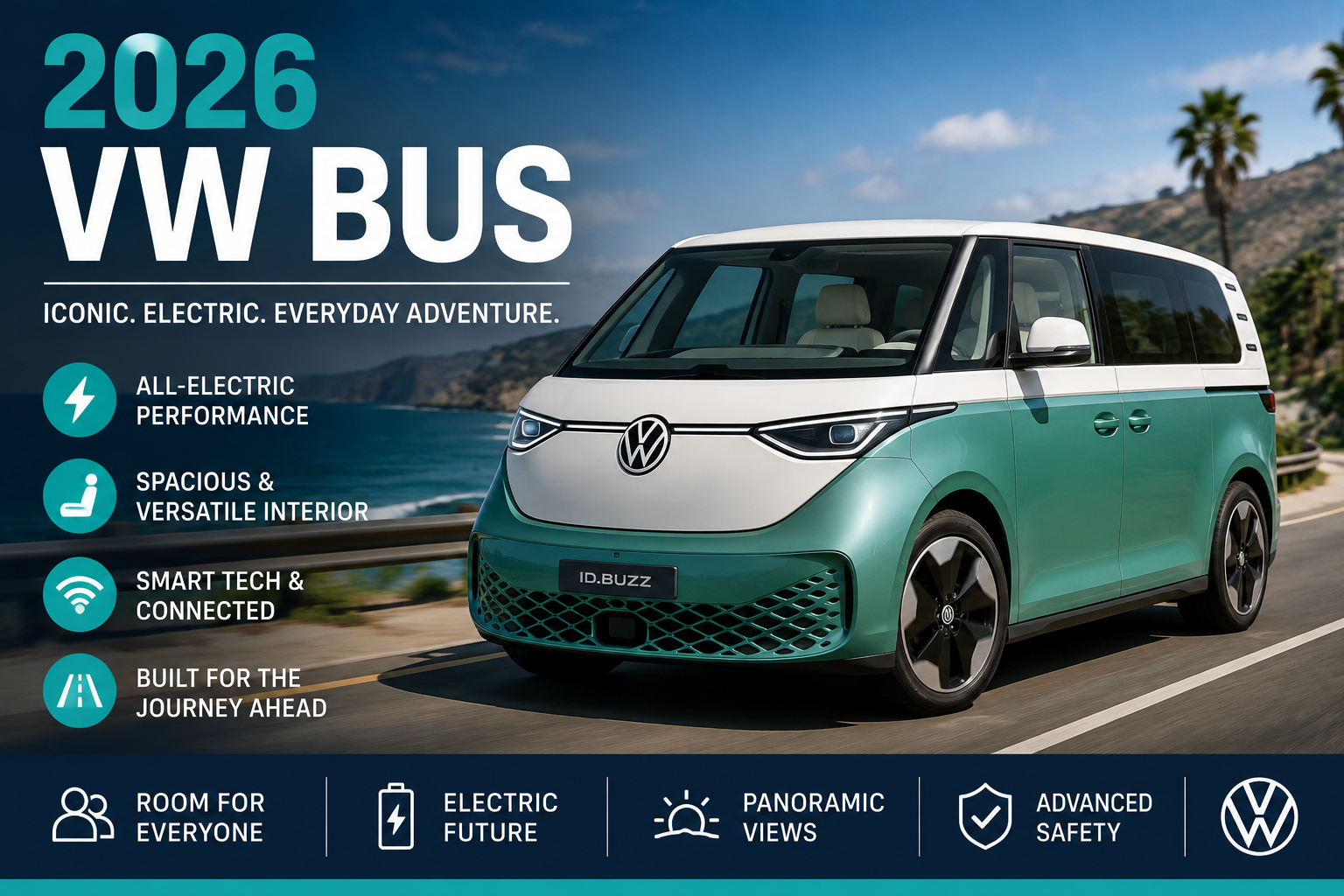
Searching for a 2026 VW Bus leads to an unusual answer in the United States: there is no U.S.-market 2026 Volkswagen ID. Buzz model year. Volkswagen paused the electric Microbus after its 2025 launch and has confirmed that the ID. Buzz will return for 2027. That makes 2026 a transition year in which shoppers are choosing among leftover 2025 inventory, used 2025 models, and the incoming 2027 lineup.
The pause does not mean the modern VW Bus has disappeared. In fact, the 2027 return adds a broader trim structure, new software, one-pedal driving, easier access to Tesla Superchargers through a NACS adapter, and a camping-focused Tourer model. For buyers shopping during 2026, the real question is not simply whether a VW Bus exists. It is whether a discounted 2025 ID. Buzz is a better buy than waiting for the updated 2027 version.
Key Takeaways
| • Volkswagen skipped the 2026 ID. Buzz model year in the U.S., so a factory-new vehicle advertised as a “2026 VW Bus” should be checked carefully.
• The 2025 ID. Buzz starts at $59,995 before destination, with EPA-estimated range of 234 miles for rear-wheel drive and 231 miles for 4Motion all-wheel drive. • The 2027 ID. Buzz is confirmed for the U.S. with Pro S RWD, Pro S 4Motion, Tourer 4Motion, and Pro S Plus 4Motion trims. • As of August 2026, Volkswagen has not announced final U.S. pricing for the 2027 ID. Buzz. • A leftover 2025 can make sense at a strong discount, while buyers who care about software, one-pedal driving, Tesla Supercharger access, or camping features may prefer to wait for 2027. |
The 2026 VW Bus Is Really a Three-Choice Shopping Story
Instead of thinking of 2026 as a normal model year, it is more useful to think of it as a fork in the road. U.S. shoppers have three realistic paths: buy remaining new 2025 inventory, buy a used 2025 ID. Buzz, or wait for the 2027 model that Volkswagen says will return to dealerships in the fall of 2026.
| Buying path | What you get | Main advantage | Main trade-off |
| New leftover 2025 | Current ID. Buzz hardware and warranty | Potential dealer discount and immediate availability | Older software and no 2027 upgrades |
| Used 2025 | Same basic EV package with depreciation already absorbed | Possible lower purchase price | Condition, battery history, and financing can vary |
| Wait for 2027 | Updated trim lineup and new features | Better software, NACS adapter, one-pedal driving, Tourer option | Final pricing and exact EPA figures are not yet announced |
Why Is There No 2026 Volkswagen ID. Buzz in the U.S.?
Volkswagen confirmed in late 2025 that it would not produce a U.S.-market ID. Buzz for the 2026 model year. The company described the move as a pause tied to inventory management and the transition to the 2027 vehicle, not as a permanent cancellation. The decision came after the U.S. launch faced a difficult combination of a premium price, modest driving range for a large EV, and softer electric-vehicle demand.
That distinction matters for searchers. A dealership may still sell a brand-new ID. Buzz during calendar year 2026, but the VIN and window sticker can identify it as a 2025 model. Volkswagen continues to list the 2025 ID. Buzz on its U.S. website while remaining inventory is available.
For current manufacturer details, see the Volkswagen ID. Buzz model page.
What Does the 2025 VW Bus Offer Buyers in 2026?
The U.S.-spec 2025 ID. Buzz is the long-wheelbase, three-row version of Volkswagen’s electric van. It uses a 91-kWh battery pack and was offered with rear-wheel drive or available 4Motion all-wheel drive. Rear-wheel-drive models produce 282 horsepower, while 4Motion models are rated at 335 horsepower.
Volkswagen lists an EPA-estimated 234 miles of range for rear-wheel-drive versions and 231 miles for 4Motion versions. DC fast charging can reach up to 200 kW, with Volkswagen quoting a 10% to 80% charge in as little as 26 minutes under suitable conditions. These numbers are still useful in 2026 because they define the capability of the leftover and used vehicles shoppers are actually finding.
| 2025 ID. Buzz specification | U.S. figure |
| Starting MSRP | $59,995 before destination |
| Battery | 91 kWh |
| RWD output | 282 hp |
| 4Motion output | 335 hp |
| EPA range, RWD | 234 miles |
| EPA range, 4Motion | 231 miles |
| Peak DC fast-charge rate | Up to 200 kW |
| 10% to 80% DC fast charge | As little as 26 minutes |
| Maximum cargo capacity | 145.5 cu. ft. with second row folded and third row removed |
Is the 2025 ID. Buzz Range Enough for a Family Vehicle?
For local driving, school runs, commuting, and regional trips, roughly 230 miles of EPA-rated range can be workable, especially for owners who can charge at home. The challenge appears on longer highway trips. A large van uses more energy at sustained interstate speeds, and cold temperatures, heavy loads, climate control, elevation changes, and headwinds can reduce real-world range.
That means the ID. Buzz demands more charging planning than some three-row electric SUVs with longer EPA ratings. The upside is a high 200-kW peak fast-charge rate and a relatively quick quoted 10% to 80% session. The downside is that a fast charging stop cannot fully compensate for having fewer miles between stops on a long road trip.
How Practical Is the Modern VW Bus Inside?
Space is where the ID. Buzz makes its strongest case. The tall body, long wheelbase, dual sliding rear doors, and boxy profile give it a cabin that feels purpose-built for passengers. Depending on configuration, the U.S. model seats six or seven people. Volkswagen also quotes 145.5 cubic feet of maximum cargo capacity when the second row is folded and the removable third row is taken out.
The elevated seating position and large glass area help create the airy feel buyers associate with the old Volkswagen Bus, but the packaging is entirely modern. Available features include an electrochromic panoramic glass roof, multiple USB ports, wireless smartphone connectivity, driver-assistance technology, and a three-row layout that is more van-like than crossover-like.
What Changes When the VW Bus Returns for 2027?
The 2027 ID. Buzz is more than a simple model-year relabel. Volkswagen has announced a revised four-trim lineup: Pro S RWD, Pro S 4Motion, Tourer 4Motion, and Pro S Plus 4Motion. The new Pro S 4Motion gives buyers an all-wheel-drive choice below the top trim, while the Tourer is aimed directly at owners who want to use the van for camping and overnight travel.
The Tourer adds a fold-out mattress and platform, window blinds, front-window ventilation panels, an exterior table and chairs, and an Overnight Mode that adapts vehicle functions for sleeping in the van. It also brings captain’s chairs, a retractable tow hitch, an electrochromic smart roof, Area View, and distinctive wheels.
All 2027 versions are also scheduled to receive Volkswagen’s ID.S 6 infotainment software, one-pedal driving, and a NACS-to-CCS adapter that provides access to compatible Tesla Superchargers. Volkswagen is simplifying the color palette as well, with two-tone combinations including a Candy White over Cherry Red scheme that deliberately echoes the classic Type 2 Microbus.
For the latest announced 2027 changes, see the Car and Driver 2027 ID. Buzz overview.
What Will the 2027 VW Bus Cost?
As of August 8, 2026, Volkswagen has not published final U.S. pricing for the 2027 ID. Buzz. That is important because some online pages show estimates rather than confirmed sticker prices. The outgoing 2025 Pro S started at $59,995 before destination, and the launch lineup moved higher with Pro S Plus, 1st Edition, and all-wheel-drive configurations.
Until Volkswagen releases a 2027 price sheet, shoppers should treat any exact 2027 MSRP as provisional. The better comparison is the actual transaction price of a leftover 2025 against the eventual 2027 window sticker. A large discount can make the older vehicle attractive, but a small discount may not compensate for giving up the updated infotainment system, new charging convenience, and stronger trim choices.
Should You Buy a Leftover 2025 ID. Buzz or Wait for 2027?
A leftover 2025 makes the strongest case when the dealer discount is substantial and the buyer values the vehicle’s space and styling more than the incoming software changes. It can also make sense for shoppers who need a three-row EV immediately and already have convenient home charging.
Waiting for 2027 is easier to justify if you want all-wheel drive without stepping directly to the highest trim, plan to use Tesla Superchargers regularly, prefer one-pedal driving, or are specifically interested in the Tourer’s built-in overnight setup. The 2027 also avoids buying a brand-new vehicle that is already one model year behind on paper.
| Priority | Better fit | Why |
| Lowest possible transaction price | Discounted 2025 | A strong dealer incentive can outweigh missing updates |
| Latest software and controls | 2027 | ID.S 6 and one-pedal driving are new |
| Camping and overnight use | 2027 Tourer | Factory sleep setup and Overnight Mode |
| Immediate availability | 2025 | Existing inventory can be purchased now |
| All-wheel drive at a lower trim level | 2027 Pro S 4Motion | New trim broadens AWD access |
What Should You Check Before Buying a 2025 ID. Buzz in 2026?
Because the 2025 model is now effectively leftover inventory, the purchase process should look slightly different from buying a newly launched model. Confirm the build date, odometer reading, time spent in dealer inventory, battery state of charge, tire condition, software update status, and whether the vehicle has been used extensively for demonstrations or test drives.
Also compare the full out-the-door price, not only the advertised discount. Dealer accessories, paint protection packages, financing terms, and add-on products can erase part of a headline markdown. Ask the dealer to show the original window sticker and a complete buyer’s order so you can see the real reduction from MSRP.
Finally, verify charging compatibility for the exact model year. Volkswagen says the 2025 ID. Buzz can use compatible Tesla Superchargers with an approved NACS DC adapter, but the adapter is sold separately on the 2025 model. The 2027 announcement says the adapter will be included.
Does the ID. Buzz Still Make Sense Against Three-Row EV Rivals?
The ID. Buzz is difficult to compare directly because almost nothing else combines true minivan packaging, dual sliding doors, three rows, and retro styling in a fully electric vehicle. Three-row electric SUVs such as the Kia EV9 and Hyundai Ioniq 9 may offer a more conventional shape and, depending on configuration, longer-range choices. The Volkswagen counters with better van-style access, a huge maximum cargo area, and a design that is intentionally different from the rest of the EV market.
That makes the decision less about a spec-sheet victory and more about use. Families who prioritize highway range above all else may prefer an EV SUV. Buyers who value sliding doors, open cabin space, visibility, personality, and a flexible three-row interior may find the ID. Buzz worth the compromises.
Frequently Asked Questions
Is there a 2026 Volkswagen ID. Buzz for sale in the U.S.?
No U.S.-market 2026 model year was produced. New ID. Buzz vehicles sold during 2026 are generally leftover 2025 inventory, while the model is scheduled to return for 2027.
Is the 2026 VW Bus gas, hybrid, or electric?
The modern Volkswagen Bus sold in the U.S. is the fully electric ID. Buzz. Volkswagen has not announced a U.S. gasoline or hybrid version.
How far can the VW ID. Buzz go on a charge?
The 2025 rear-wheel-drive ID. Buzz is EPA-rated at 234 miles, while the 2025 4Motion version is rated at 231 miles. Final 2027 EPA range figures should be checked once Volkswagen publishes them.
How much does the VW Bus cost?
The 2025 ID. Buzz Pro S has a starting MSRP of $59,995 before destination. Actual 2026 transaction prices for leftover inventory vary by dealer, location, trim, incentives, and vehicle age. Final 2027 pricing has not yet been announced as of August 8, 2026.
When will the 2027 ID. Buzz arrive?
Volkswagen has confirmed the 2027 return, and current reporting points to U.S. sales resuming in fall 2026. Exact dealer arrival timing can vary.
Will the 2027 ID. Buzz have a camper version?
Yes. The new Tourer 4Motion is designed for overnight use and includes a fold-out sleeping setup, blinds, ventilation panels, outdoor furniture, and Overnight Mode software.
For an independent update on the announced return timing and Tourer trim, see Cars.com’s 2027 ID. Buzz coverage.
The Bottom Line
The phrase “2026 VW Bus” describes a shopping year more than an actual U.S. model year. Volkswagen skipped the 2026 ID. Buzz, leaving shoppers to choose between remaining 2025 vehicles and the confirmed 2027 return. The 2025 remains an unusually spacious, distinctive electric van with up to 234 miles of EPA-rated range, fast charging, and genuine three-row practicality. Its biggest weaknesses are price and highway-range limitations.
The 2027 model appears designed to address some ownership complaints rather than reinvent the powertrain. New trims, better software, one-pedal driving, Tesla Supercharger access through an included adapter, and the Tourer camping package all make waiting more attractive. The smartest 2026 purchase therefore depends on the discount: if a leftover 2025 is priced aggressively enough, it can be compelling. If the discount is modest, waiting for the updated 2027 VW Bus is likely the stronger long-term choice.
Information checked for the U.S. market through August 8, 2026. Vehicle pricing, incentives, inventory, specifications, and release timing can change. Confirm current details with Volkswagen and an authorized dealer before purchasing.