

A U.S. buyer guide to price, FWD vs. AWD, real mpg, leather interior, tech, cargo space, safety, warranty, and the Sport-L vs. Sport Touring decision
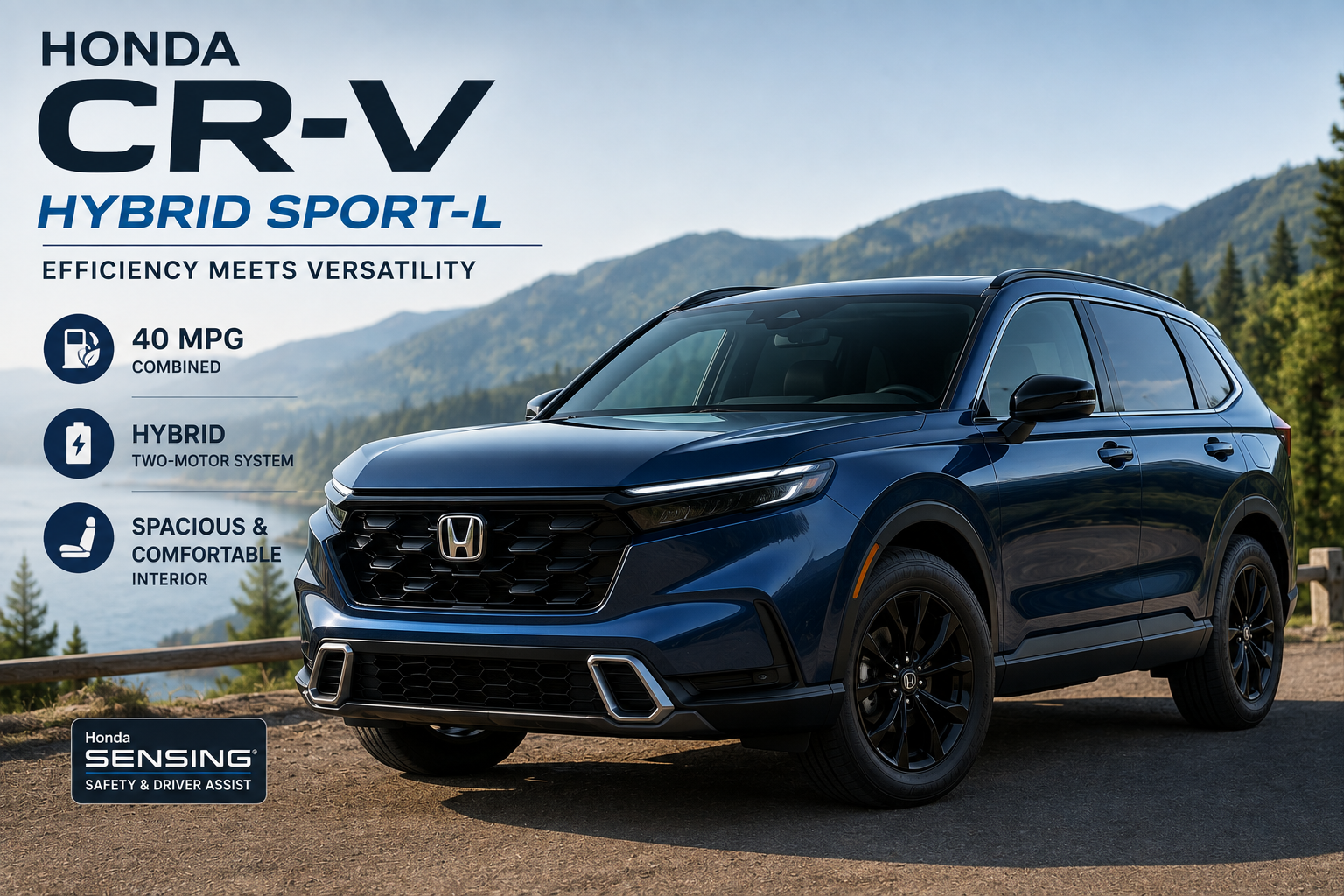
The 2026 Honda CR-V Hybrid Sport-L sits in the most interesting position in the CR-V lineup. It is not the cheapest hybrid, not the rugged TrailSport, and not the fully loaded Sport Touring. Instead, it adds the comfort features many buyers actually notice every day, including leather-trimmed seats, power front seats, a driver memory function, a power tailgate, parking sensors, and a larger digital instrument display, while keeping the efficient 204-horsepower hybrid system.
That makes the Sport-L look like an obvious value choice, especially with front-wheel drive. But the math changes when all-wheel drive is added. A Sport-L AWD is only a little more than $2,000 below the Sport Touring, which adds standard AWD, larger wheels, Bose audio, Google built-in, a hands-free tailgate, and other premium equipment. So the real question is not simply whether the Sport-L is good. It is whether the version you configure leaves enough price separation from the trims above and below it.
| The quick verdict
The 2026 CR-V Hybrid Sport-L FWD is arguably the best value in the hybrid lineup for buyers who want leather, better cabin equipment, 40-mpg combined fuel economy, and no need for AWD. The AWD Sport-L is still a strong SUV, but its smaller price gap to Sport Touring makes the top trim much more tempting. |
Key Takeaways
- The 2026 CR-V Hybrid Sport-L starts at $38,725 before Honda’s $1,450 destination charge, putting a front-wheel-drive vehicle at about $40,175 before options, taxes, and registration.
- Adding Real Time AWD raises the Sport-L by about $1,500, bringing the delivered MSRP to roughly $41,675 before optional paint or accessories.
- The hybrid system produces 204 total system horsepower and uses a 2.0-liter Atkinson-cycle four-cylinder with two electric motors.
- FWD Sport-L models are EPA-rated at 43 mpg city, 36 highway, and 40 combined. AWD models drop to 40 city, 34 highway, and 37 combined.
- Sport-L adds leather-trimmed seats, power front seats with driver memory, an 8-speaker 320-watt audio system, power tailgate, parking sensors, 10.2-inch digital gauge cluster, moonroof, heated front seats, and 18-inch gloss-black wheels.
- The 2026 refresh gives every CR-V Hybrid a 9-inch touchscreen, wireless Apple CarPlay and Android Auto, and wireless phone charging.
- Cargo volume is 36.3 cubic feet behind the second row and up to 71.8 cubic feet behind the front seats in hybrid models.
- Maximum towing capacity is only 1,000 pounds, so buyers with larger campers or boats should look beyond the CR-V Hybrid.
- The 2026 CR-V earns strong results in several IIHS crash tests, but its updated moderate-overlap front test is rated Poor because of rear-passenger restraint performance. That is worth knowing when comparing family SUVs.
The $3,095 Question: What Does Sport-L Add Over Sport Hybrid?
Honda lists the 2026 Sport Hybrid at $35,630 and the Sport-L Hybrid at $38,725 before destination, a difference of $3,095 in front-wheel-drive form. Both use the same 204-hp two-motor hybrid powertrain, both can be ordered with AWD, and both wear 18-inch gloss-black wheels.
The Sport-L premium therefore buys comfort and convenience rather than speed. For a buyer keeping the vehicle five to ten years, those daily-use upgrades may matter more than an extra horsepower figure.
| Feature | Sport Hybrid | Sport-L Hybrid |
| Hybrid output | 204 hp | 204 hp |
| Front-wheel drive | Standard | Standard |
| AWD | Available | Available |
| Seat material | Cloth | Leather-trimmed |
| Front seats | Heated | Heated, power-adjustable, driver memory |
| Driver display | 7.0-inch | 10.2-inch digital cluster |
| Audio | Standard system | 8-speaker, 320-watt system |
| Power tailgate | No | Yes |
| Front/rear parking sensors | No | Yes |
| Moonroof | Yes | Yes |
If leather, memory seating, a power passenger seat, parking sensors, and a power tailgate are features you already know you want, Sport-L is easier to justify than buying a Sport and trying to recreate those upgrades later. If you mainly care about fuel economy and the hybrid drivetrain, the regular Sport delivers nearly the same driving experience for less.
The $2,325 Question: Is Sport Touring Worth It Over Sport-L AWD?
This is where the lineup gets more complicated. The Sport-L starts at $38,725 before destination, while Sport Touring starts at $42,550. That looks like a $3,825 difference until you remember that Sport Touring includes AWD as standard.
Once AWD is added to a Sport-L, the price climbs to about $40,225 before destination, or roughly $41,675 including the current destination charge. A Sport Touring lands at about $44,000 including destination. The effective gap is therefore only about $2,325.
| Feature | Sport-L AWD | Sport Touring AWD |
| Approx. MSRP incl. destination | $41,675 | $44,000 |
| AWD | Standard after option is added | Standard |
| Wheels | 18-inch gloss black | 19-inch gloss black |
| Audio | 8-speaker, 320 watts | Bose premium system |
| Google built-in | No | Yes |
| Power tailgate | Standard | Hands-free access |
| Acoustic front glass | No | Yes |
| Overall mission | Premium value | Fully loaded hybrid CR-V |
| The trim sweet spot changes with drivetrain
Sport-L FWD gives you a meaningful price advantage and the best EPA fuel economy. Sport-L AWD is still good value, but buyers who want premium audio, quieter highway cruising, Google built-in, and a hands-free tailgate should price a Sport Touring before deciding. |
Should You Buy the Sport-L With FWD or AWD?
The choice has a bigger effect on value than it first appears because AWD changes both purchase price and fuel economy. For buyers in warm climates, flatter regions, and mostly paved-road use, the front-drive Sport-L is the configuration that makes the strongest financial case.
| Sport-L FWD | Sport-L AWD | |
| Approx. MSRP incl. destination | $40,175 | $41,675 |
| EPA city | 43 mpg | 40 mpg |
| EPA highway | 36 mpg | 34 mpg |
| EPA combined | 40 mpg | 37 mpg |
| Fuel used over 12,000 mi at combined rating | About 300 gal | About 324 gal |
| Best fit | Efficiency and value | Snow, wet hills, loose surfaces, added traction |
At 12,000 miles per year, the EPA combined ratings imply a difference of roughly 24 gallons of gasoline between FWD and AWD. That is not enough to make AWD financially painful, but it is a recurring cost on top of the roughly $1,500 initial price increase.
AWD makes more sense for drivers who routinely encounter snow, steep wet roads, gravel driveways, or unpaved access roads. It should not be treated as a substitute for appropriate tires. In winter conditions, tire quality can matter as much as which wheels receive power.
What Does the 204-HP Hybrid System Feel Like in Everyday Driving?
Honda’s hybrid system behaves differently from a conventional engine-and-transmission setup. A 2.0-liter Atkinson-cycle four-cylinder works with two electric motors, and the electric drive motor handles much of the work at lower and moderate road speeds. At higher speeds, the gasoline engine can connect more directly to the wheels.
The result is smooth low-speed response and strong initial torque without the need to plug the vehicle in. Honda rates the combined system at 204 horsepower. Car and Driver recorded 0 to 60 mph in 7.1 seconds in an AWD Sport Touring Hybrid, which gives a useful indication of the powertrain’s capability even though that result was not from a Sport-L specifically.
The CR-V Hybrid is therefore quick enough for merging, commuting, and family use, but it is not a performance SUV. Its appeal is that it feels responsive in ordinary driving while using much less fuel in city traffic than the turbocharged nonhybrid CR-V.
How Good Is the 2026 CR-V Hybrid Sport-L MPG in the Real World?
The front-drive Sport-L carries the headline EPA numbers: 43 mpg city, 36 highway, and 40 combined. AWD models are rated at 40 city, 34 highway, and 37 combined.
The city number is higher because hybrids recover energy during braking and can use the electric motor more often at lower speeds. On steady interstate driving, the gasoline engine does more continuous work, so the hybrid advantage becomes smaller.
Car and Driver’s 75-mph test of an AWD Sport Touring Hybrid returned 35 mpg, one mpg better than that trim’s 34-mpg EPA highway rating. That is encouraging for long-distance drivers, but it should be treated as a benchmark for the powertrain rather than a guaranteed Sport-L result.
For the official city, highway, and combined ratings for a specific drivetrain, check FuelEconomy.gov. EPA estimates are standardized comparison figures, while actual results vary with speed, weather, tire pressure, terrain, traffic, and driving style.
What Is the Sport-L Interior Like?
Sport-L is where the CR-V Hybrid starts to feel notably more upscale without changing the dashboard into a screen-heavy luxury interface. The layout remains simple, with physical climate-control knobs, a conventional-looking center console, a 9-inch touchscreen, and a 10.2-inch digital instrument cluster.
- Leather-trimmed seats with orange contrast stitching.
- Heated front seats.
- Power-adjustable front seats with driver memory.
- Leather-wrapped steering wheel with orange stitching.
- Dual-zone automatic climate control.
- One-touch power moonroof.
- 8-speaker, 320-watt audio system.
- Wireless Apple CarPlay and Android Auto.
- Wireless phone charging.
- Front and rear USB ports.
- Power tailgate with programmable height.
- Front and rear parking sensors.
The missing features help explain why Sport Touring still exists. Sport-L does not include the Touring’s Bose audio system, Google built-in, hands-free tailgate, or larger 19-inch wheels. For buyers who use CarPlay or Android Auto anyway, the lack of Google built-in may be a minor issue.
Honda’s 2026 CR-V Sport-L Hybrid build page lists the current trim equipment, starting MSRP, available AWD, and technology features.
Is There Enough Room for a Family?
Space remains one of the CR-V’s biggest strengths. Honda lists 103.5 cubic feet of passenger volume for hybrid trims, and the rear seat offers enough legroom for adults to use comfortably on longer trips.
Hybrid battery packaging reduces cargo space slightly compared with nonhybrid CR-V trims, but the difference is not severe. The Sport-L provides 36.3 cubic feet behind the second row and up to 71.8 cubic feet with the rear seat folded.
| Space Measure | 2026 CR-V Hybrid Sport-L |
| Seats | 5 |
| Passenger volume | 103.5 cu ft |
| Cargo behind second row | 36.3 cu ft |
| Maximum cargo behind first row | 71.8 cu ft |
| Fuel tank | 14.0 gal |
| Rear seat | 60/40 split, reclining and fold-down |
Can the CR-V Hybrid Sport-L Tow?
Yes, but towing is one of the clearest limits of the CR-V Hybrid. Honda rates hybrid versions to tow up to 1,000 pounds when properly equipped with the required towing accessories.
That is enough for a small utility trailer, lightweight cargo trailer, or certain small recreational loads, but it is not a strong choice for a conventional travel trailer or larger boat. The nonhybrid CR-V is rated higher, and several hybrid rivals also offer more towing capacity.
How Safe Is the 2026 Honda CR-V?
Honda equips the Sport-L with the Honda Sensing suite, including Collision Mitigation Braking, Road Departure Mitigation, adaptive cruise control with low-speed follow, Lane Keeping Assist, Traffic Sign Recognition, blind-spot monitoring with cross-traffic monitoring, and front and rear parking sensors.
The current IIHS results are more nuanced than a simple five-star-style summary. The 2026 CR-V has Good ratings in the small-overlap front and updated side tests, and its headlights are rated Good. However, the updated moderate-overlap front evaluation is rated Poor, primarily because the rear-passenger restraint performance was rated Poor even though the vehicle’s structure and driver injury measures were strong.
Families comparing crash-test details can review the full IIHS 2026 Honda CR-V ratings. Looking at the individual test categories is more useful than assuming one overall label tells the entire safety story.
What Does Honda Cover After You Buy It?
Honda’s basic new-vehicle warranty covers three years or 36,000 miles, while the powertrain warranty runs five years or 60,000 miles. The high-voltage hybrid battery carries an 8-year/100,000-mile limited warranty under Honda’s national coverage, with longer terms possible where California emissions rules apply.
Honda Service Pass covers specified factory-scheduled maintenance during the first 12 months or 12,000 miles, whichever comes first, when the Maintenance Minder calls for service. The program includes eligible oil and filter service, tire rotation, and a multipoint inspection.
The hybrid system does not require plugging in, and routine maintenance remains similar to a conventional vehicle. Regenerative braking can reduce some friction-brake use, but tires, fluids, filters, suspension components, and normal wear items still require attention.
Who Should Buy the 2026 CR-V Hybrid Sport-L?
- Buy the FWD version if you want the strongest mix of equipment, 40-mpg combined efficiency, and a meaningful price gap below Sport Touring.
- Choose AWD if you regularly deal with snow, steep wet roads, or loose surfaces and value extra traction more than the fuel-economy penalty.
- Choose Sport-L over Sport if leather, power seats, memory, parking sensors, and a power tailgate are everyday features you care about.
- Choose Sport-L over Sport Touring if Bose audio, Google built-in, hands-free tailgate operation, and 19-inch wheels are not worth the added cost to you.
- Consider Sport Touring instead if you already planned to add AWD to Sport-L and prefer a fully equipped vehicle from the factory.
Who Should Skip the Sport-L?
Skip it if your priority is simply the lowest-cost CR-V Hybrid. The regular Sport uses the same 204-hp powertrain and returns the same EPA fuel economy with equivalent drivetrains.
It may also be the wrong vehicle if towing is a major part of your lifestyle. A 1,000-pound limit is restrictive for buyers with campers, larger boats, or heavier utility trailers.
Finally, buyers who want a genuinely premium audio and infotainment experience should compare Sport Touring. Once AWD is added to Sport-L, the price difference is small enough that the Touring’s added equipment can represent better value depending on what you use.
Frequently Asked Questions
How much is a 2026 Honda CR-V Hybrid Sport-L?
Honda lists the Sport-L Hybrid at $38,725 before a $1,450 destination charge. That puts a front-wheel-drive example at about $40,175 before optional paint, accessories, taxes, registration, and dealer charges. AWD adds roughly $1,500.
What is the MPG of the 2026 CR-V Hybrid Sport-L?
The front-wheel-drive Sport-L is EPA-rated at 43 mpg city, 36 highway, and 40 combined. The AWD version is rated at 40 city, 34 highway, and 37 combined.
Does the CR-V Hybrid Sport-L have leather seats?
Yes. Sport-L includes leather-trimmed seats with orange stitching, heated front seats, power front-seat adjustment, and a driver memory function.
Does the 2026 Sport-L have wireless Apple CarPlay?
Yes. The 2026 Sport-L includes a 9-inch touchscreen with wireless Apple CarPlay and Android Auto, plus wireless phone charging.
Does the Sport-L have parking sensors?
Yes. Front and rear parking sensors are standard on the 2026 Sport-L. They are an important distinction from some lower hybrid trims.
Is the 2026 Sport-L AWD standard?
No. Front-wheel drive is standard and Real Time AWD is optional. Sport Touring and TrailSport Hybrid use AWD as standard equipment.
How much can the CR-V Hybrid Sport-L tow?
The CR-V Hybrid is rated to tow up to 1,000 pounds when properly equipped with the required towing accessories.
Is Sport-L better than Sport Touring?
It is better value for many front-wheel-drive buyers because it keeps the premium essentials while costing significantly less. For AWD buyers, Sport Touring becomes harder to ignore because the effective price gap drops to roughly $2,325 before optional paint and accessories.
Final Verdict: Sport-L Is the Sweet Spot, but Mostly in FWD Form
The 2026 Honda CR-V Hybrid Sport-L succeeds because it adds the equipment that makes a vehicle feel better to live with without changing the efficient, smooth hybrid formula underneath. Leather, power seats, driver memory, parking sensors, a power tailgate, and the larger digital cluster are meaningful upgrades rather than decorative trim.
The strongest configuration is the front-wheel-drive Sport-L. At about $40,175 including destination before options, it maintains a useful gap below Sport Touring while delivering the best 40-mpg combined rating in the lineup. For drivers who do not need AWD, it is difficult to find a major reason to spend more.
The AWD version requires a more careful decision. Once its price reaches roughly $41,675, Sport Touring is only about $2,325 away. At that point, Bose audio, Google built-in, quieter front glass, standard AWD, larger wheels, and the hands-free tailgate can make the top trim worth the stretch.
That is why the Sport-L is not automatically the best CR-V Hybrid for everyone. It is the best CR-V Hybrid for buyers who understand exactly which features they value and avoid paying for the ones they do not.
Research note: This article was updated for the U.S. market using information available in August 2026. Pricing, trim equipment, EPA fuel-economy ratings, warranty details, and safety information were checked against current Honda, EPA, IIHS, and Car and Driver information. Dealer prices, incentives, destination charges, options, and equipment availability can change. Verify the window sticker and VIN before purchase.